Do Betta Fish Need Light? A Practical Day and Night Schedule
Bettas need a regular day-and-night cycle. An aquarium light makes that cycle easier to control and may support live plants, but the fish does not need intense illumination or an aquarium lamp left on all night.
Consider the light reaching the tank from the room as well as the fixture above it. Switching the aquarium lamp off does not provide darkness if a bright room light stays on beside the glass.
A workable starting schedule
RSPCA betta-care guidance advises limiting aquarium lighting to no more than 10 hours a day and providing at least 8 hours of darkness. A consistent timer is more useful than turning the lamp on whenever you happen to pass the tank.
For a typical low-light planted betta aquarium, you might initially schedule the fixture for about 8 hours, then assess plant growth and algae alongside ambient light. This is a practical starting arrangement, not a claim that every plant or aquarium has identical requirements.
| Part of the day | Example routine |
|---|---|
| Morning | Normal room daylight; avoid abrupt handling in a dark tank |
| Scheduled daytime period | Aquarium lamp on for a consistent planned interval |
| Evening | Lamp off at the same time each day |
| Overnight | A genuinely dark rest period; no decorative night lamp |
If you work late, shift the schedule so you can enjoy the aquarium while still preserving a regular dark period. Do not add a second long viewing session that effectively keeps the fish illuminated around the clock.
Brightness matters as well as hours
Choose lighting that suits the tank’s dimensions and plants, with shade and cover available for the fish. A powerful planted-tank fixture is not automatically a better choice for a betta. Dimming, positioning and planting may be needed to avoid harsh exposure.
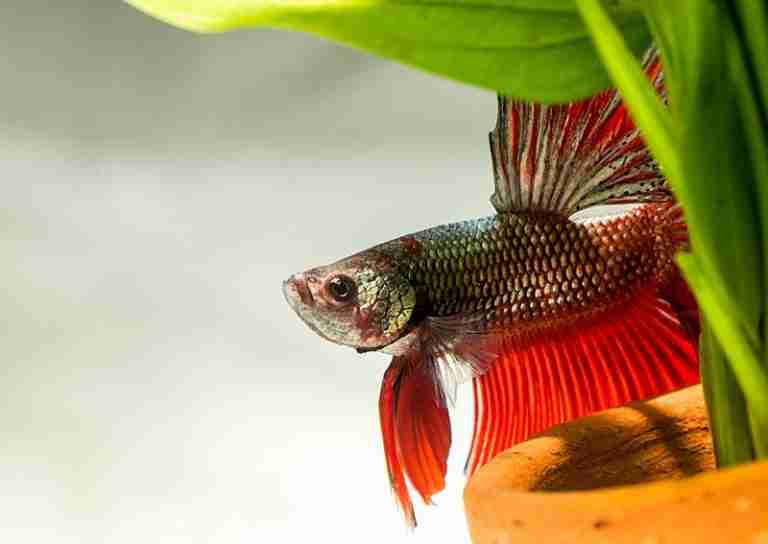
Floating plants, broad leaves and safe shelters can provide choices between brighter and shaded areas. Maintain access to the water surface and do not let plants obstruct filtration. Plastic decorations should have smooth surfaces that will not damage fins.
If the fish consistently avoids the lit area, check brightness, reflections, cover and other causes of stress. Do not conclude that the fish “hates light” from hiding alone. Water quality, flow, illness and disturbance can also affect its behaviour.
Can room light be enough?
It may provide a day-and-night cue if it is consistent and suitable. Whether it supports plants is a separate question. A tank in a dim room may need a dedicated fixture for viewing and plant growth, while one beside a sunny window can receive excessive light and heat.
Avoid direct sun as a lighting strategy. It is difficult to control, can encourage algae and may heat the water unpredictably. Keep the aquarium’s temperature independently monitored.
Do blue or red lights count as darkness?
Do not assume a coloured lamp is invisible to a betta. Decorative blue “moonlight” is still artificial illumination, and a colour name on the box does not establish that a fish cannot perceive it.
Provide an actual dark period rather than leaving coloured LEDs on through the night. If a fixture has dawn or dusk effects, include those illuminated periods when planning the total schedule. Count the dawn and dusk fades as part of the time the tank is illuminated.
The betta night-vision guide explains why low-light vision and a need for a night lamp are different questions.
Choosing a fixture without buying too much light
Look for appropriate size, safe mounting, a suitable timer and useful intensity control. Check electrical safety around water and whether the fixture and lid work together. Bettas can jump, so installing a light should not mean abandoning the secure cover.
Plant needs vary substantially. A low-demand planting arrangement can be easier to manage than buying a very bright fixture and then trying to solve algae with chemicals. More light can increase the demands on plant nutrition and maintenance; it is not a stand-alone plant-health solution.
My recommended products
Affiliate links · I may earn a commission at no extra cost to you.
For a betta setup, I would prioritise a good timer and useful brightness control over buying the most powerful light. Use the affiliate links below to compare each model’s dimensions, mounting and current specifications, then match it to the tank and plants.
If the light causes reflections
A bright tank in a dark room can make reflections more noticeable. A betta may flare at what appears to be another fish. Check the room-to-tank lighting balance and the fish’s behaviour before deciding aggression requires a tank mate or a mirror.
Use planting and safe cover, adjust excessive brightness and avoid prolonged displays against reflections. If you use a background or external barrier, keep ventilation and equipment access clear and check whether the fish settles.
Algae: adjust the whole routine
Long illumination can contribute to algae, but it is not the only cause. Review feeding, accumulated waste, maintenance, plant condition and the light’s intensity. Shorten excessive exposure gradually and keep records so you can judge the change.
Do not make permanent darkness the fish’s normal environment to hide an algae problem. Likewise, extending light indefinitely to help a struggling plant can create new problems. Identify the plant’s needs and the aquarium’s conditions.
What lighting research tells us
A study of photoperiod and betta reproduction compared several light-and-dark regimes under experimental conditions. That is evidence that lighting schedules have biological relevance; it does not identify one schedule that suits every home aquarium or support leaving the light on continuously.
For everyday care, a consistent cycle, a dark rest period, appropriate plant lighting and shaded choices are the useful priorities. If the fish remains unusually inactive or distressed after the environment is corrected, investigate health and water quality rather than endlessly changing the lamp.